
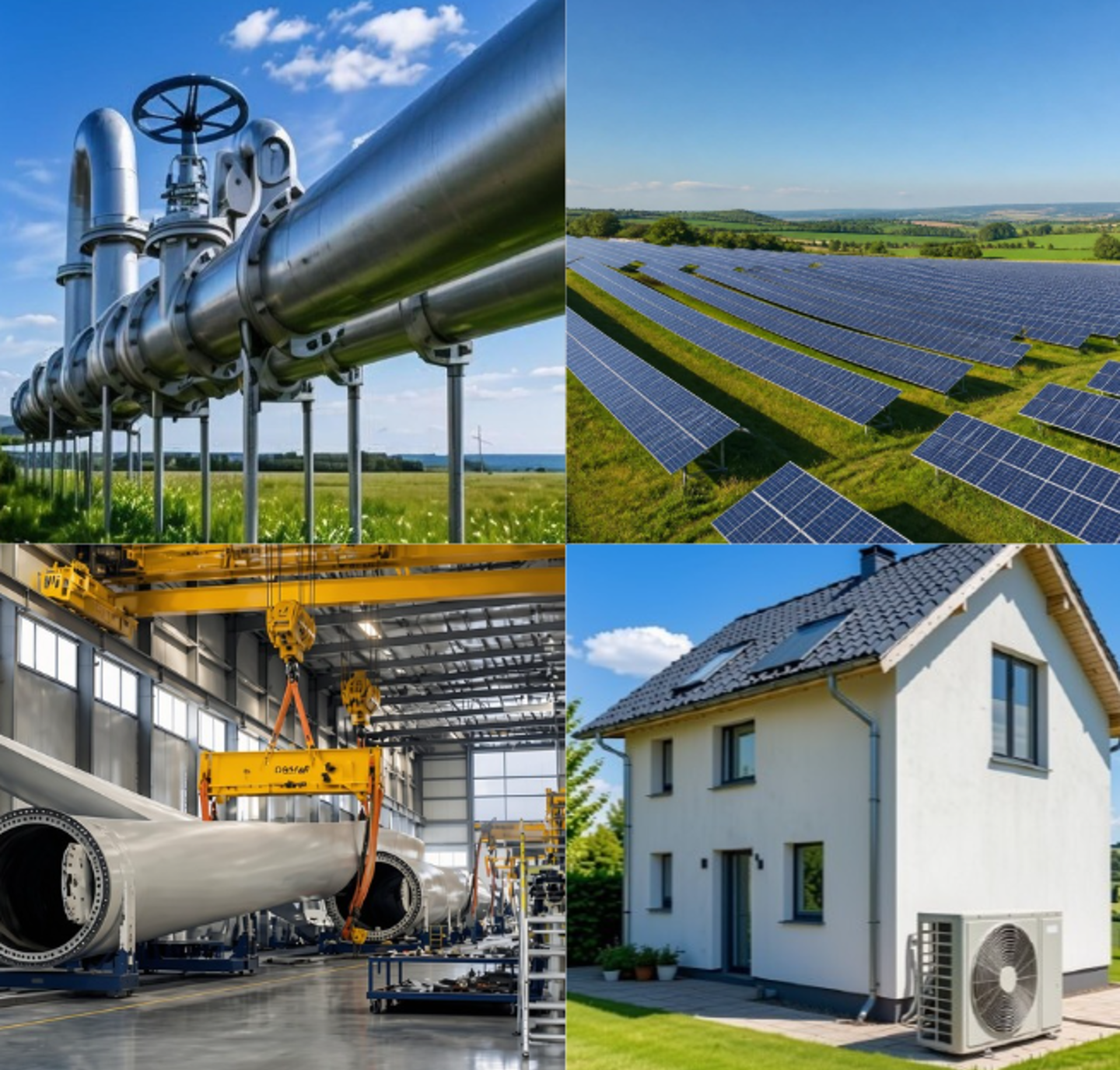

The transition to clean energy is creating new opportunities for jobs, skills development and economic growth across the Midlands. Effective workforce planning depends on understanding the workforce already supporting clean energy delivery, the occupations likely to be needed in the future, and the strengths and limitations of the evidence available to inform decisions.
Aim
The Midlands Clean Energy Workforce Mapping Study examines the evidence available to understand current and future clean energy workforce demand across the region. Commissioned by the Department for Energy Security and Net Zero (DESNZ), through the Office for Clean Energy Jobs (OCEJ), and delivered by the Midlands Net Zero Hub (MNZH), it forms part of a wider programme of regional workforce mapping across England's Net Zero Hub regions.
The study explores current workforce capacity, future demand signals, priority occupations, differences between national and regional evidence, and the sectors and projects likely to influence future workforce demand.
Approach
The research draws on 24 datasets, 51 reports and studies, engagement with all three Midlands Mayoral Strategic Authorities, and responses from 23 local authorities.
It combines the national Clean Energy Jobs Plan (CEJP) with Midlands-specific Low Carbon and Environmental Goods and Services (LCEGS[1]) data, labour market and skills evidence, project pipeline information and stakeholder intelligence. This layered approach enables national clean energy priorities to be considered alongside the economic and workforce characteristics of individual places across the Midlands.
Key findings
The study identifies a substantial and growing clean energy-related workforce across the Midlands. Mapped LCEGS analysis estimates 111,701 full-time equivalent (FTE) roles in 2023/24, an increase of approximately 22.8% since 2019/20.
Significant workforce strengths are identified in wind-related supply chains, Building Technologies and photovoltaic (PV), alongside strategically important capability in Nuclear Power and Energy Management. Future demand is likely to span skilled construction trades, electricians, heating engineers, engineers and technicians, manufacturing, project management and planning, and digital, data and control systems roles.
The research also highlights the importance of both major strategic infrastructure and locally delivered projects. West Burton STEP, solar and battery storage, heat networks, retrofit and public sector decarbonisation all provide signals of future workforce and skills requirements.
Outcome
The study finds that existing evidence is sufficient to support strategic workforce planning but should not be treated as a precise forecasting model. No single dataset provides a complete picture: national and regional sources differ in their definitions, methodologies, classifications and geographical coverage, while evidence remains weaker for precise local occupation forecasts, project-specific job estimates and longer-term demand to 2050.
The report identifies priorities for strengthening future workforce intelligence, including more consistent definitions, improved local and occupation-level evidence, stronger project-to-workforce mapping, better links between workforce demand and skills provision, and greater regional coordination of workforce evidence.
Who is this resource for?
The study provides an evidence resource for local and combined authorities, employers, skills and training providers, government, project developers and delivery partners seeking to understand workforce opportunities, plan interventions and support delivery of the Midlands' clean energy transition.